Elizabeth A. Garcia
  • Home
    • Earlier Author News
  • Books
    • I Cant Hear You
    • And Justice for Some
    • Raw Deal
    • The Trail of a Rattler
    • The Reluctant Cowboy
    • Hard Falls
    • Border Ghosts
    • Darker Than Black
    • The Beautiful Bones
    • One Bloody Shirt at a Time
  • Bio
  • Blog
  • Fan Page
  • Mystery Weekends

"Did You Bring Anything from Mexico?"

5/30/2014

0 Comments

 
At the Border Patrol checkpoint between Terlingua and Alpine I have often been asked, “Did you bring anything from Mexico?”

“No” is my answer, but the question surprises me. Why do they assume I went there? Terlingua, while close to Mexico, is still not Mexico.

The last time I was asked that question I thought: I’m lying. I have so much from Mexico no one would believe it. But my Mexican treasures are in my heart and soul, not in my truck.

I have memories that begin early in 1981, when I first looked across the Rio Grande from Big Bend National Park and into a foreign land that looked the same as the place I was standing. While it seemed the same, I knew it wasn’t, and I felt the lure of the differentness of it. I longed to go there. What I couldn’t have known then was that my life was about to become so intricately woven into Mexico that it would be as much a part of me as the USA.

In an earlier column I wrote about my first trip to Ojinaga. It was not great because of the person I was with, yet it was still wonderful. I enjoyed the multitude of bright colors, the foreign look of the architecture, the cobblestone streets around the plaza, and the tiny stores and restaurants that are infinitely more fascinating than our superstores.

On that trip I saw the inside of a males-only bar—not pleasant but also riveting in the way that forbidden things are. The sight of drinking, gossiping, singing, card-playing men cutting up and cutting loose and then yanking their heads up in surprise when I came through the door is forever burned into my memory.

The aromas coming from the restaurants and outside food vendors are enough to make you fall in love with the country even if nothing else appealed. In addition to the sizzle and pop on the hot grills, there are chilies stuffed with cheese, tortillas that melt in your mouth, and sticky-sweet, hot sopapillas or pan dulce. Fresh, ripe fruit in season is offered for sale: peaches, pineapple, mango, or watermelon cut up and served in cups or impaled on a stick. Don’t get me started on the big, fat, mouthwatering Mexican avocados.

Music spills out of cantinas or is performed on the street by mariachis in charro outfits or by solo musicians wearing blue jeans. Either way, who can resist it? Whether it’s a heartfelt ballad that makes you want to cry or fall in love… or if it’s a melody that makes you want to dance, sing out loud, or laugh with joy to be alive, music is one of the country’s best assets.

More than anything, I felt drawn to the smiling, friendly people who are everywhere. They gather on the sidewalks or in the plaza, exchanging news and gossip and hugs. They meet to play checkers, sing, share a cerveza, dance, or watch people. I was captivated by the “unfamiliar-ness” and the “same-as-me-ness” of them. They are beautiful, generous, open-hearted people. So I guess it was inevitable that I would fall in love with one of them.

I was warned. “He grew up differently than you.” “You went to college; he never finished grade school.” “You don’t speak the same language.” “The newness will wear off.” All of those well-meaning people were right and they were dead wrong. None of that matters when you’re in love. Who needs to talk when our deepest expressions of love have nothing to do with language? And who can’t make themselves understood to someone who is trying, with everything in them, to understand?

It’s true that I went to college and he had to quit school after fifth grade or starve. But he taught himself more by living than I ever learned by studying. He’d never heard of Shakespeare, but he could hand-dig a well, shoe a horse, make killer food, ride and rope, walk all the way to Odessa from the Rio Grande, build a sturdy wall with nothing but stones and a strong back, work hard all day and dance all night. That is only the beginning of a mile-long list.

I’ve run out of column space and never even got to mention Mexican folklore or the beaches, jungle, and mountains, or the ranches, train and bus trips, or Cuidad Chihuahua, Guadalajara, Tlaquepacque, or Mazatlán. But there’s always next week.

Did I bring anything from Mexico? No; nothing that would interest Border Patrol. And yes. Every single thing it had to offer.
0 Comments

A Rocky Adventure

5/22/2014

0 Comments

 
Back in 1981, my girlfriend Kay and I were camping in Big Bend National Park. We decided to rent a raft and float through Hot Springs Canyon at Rio Grande Village. We had never rafted, but we were assured it would be easy, the river was gentle through there, and “anyone can do it.” How hard could it be?

We lolled along, letting our fingers drag in the muddy water. The warm sun and cool breeze of a March morning were perfect accompaniments. Birds chirped and chattered and raised a ruckus in the green growth along the bank. They darted out to dip at the stars sparkling on the surface of the Rio or hopped along the shore picking at this and that.

Kay and I talked about the joy of living, even temporarily, in a place where nature ruled with such magnificence. There’s no bad view in Big Bend National Park. No matter where we camped, when we came out of the tent in the morning, we were stunned by some newly revealed cliff or peak or twisted rock formation. Or the sun would glint off something, making it shine or giving it a color it didn’t have before. It was so beautiful it made our eyes fill with tears and our hearts with wonder.

“Doesn’t it feel as though we’re the only humans to have ever been here?” Kay whispered with reverence as our raft entered the little canyon.

I agreed but my comments were hushed by the sudden shrill descending notes of a canyon wren. The sound was like nothing we’d ever heard. We didn’t know what it was but it was pure magic and not even surprising, given where we were.

To make a long story into a short column, I’ll just say that we were enamored of everything: the gentle downstream pull of a river that smelled like clean dirt, the bumpy-walled canyon, the peace, the blooming wildflowers along the shore, and the subtle lure of the foreign land drifting by next to us.

Suddenly we heard the loud sound of water pounding against stone. Never mind the assurances that it was easy and safe. Every scary whitewater tale I’d ever heard crowded into my brain. Then my relentless imagination kicked in and dragged me away with it.

“Rapids!” I screamed.

We panicked and paddled as hard as we could for the closest shore, which happened to be Mexico. We stood gasping and glad to be alive.

An old man crashed his way down an animal path and stood on the bank next to us. I spoke the only Spanish word I could remember under pressure, “Hola.”

He grinned and lifted his sombrero. “Buenos días.”

I returned the grin and felt stupid. I’d taken three years of Spanish in high school and one in college and “Hola” was all I had to offer?

There was laughter in his dark eyes, so he had evidently seen our mad dash to shore. That was embarrassing in any language.

In the manner of a true gentleman, he asked if we had a problem with the raft. What he said was, “You problem boat?” His English was not great, but it was better than my Spanish. I had a head full of his language, but it was as though I’d lost the password I needed to access that part of my brain.

Using a mix of English, mutilated Spanish, and mime, we explained that we’d heard cascading water ahead and were afraid to move forward.

He listened intently, nodding his head as we explained. Somehow he kept from laughing at us. “No is bad. You see.” He began walking and indicated that we should follow.

The “death-defying rapids” were a bend in the Rio where it widened and became shallower for a few yards. The rushing water tumbled over rocks and pebbles and caused the loud whooshing noise we’d translated into a dangerous waterfall. Well… I had translated it. My friend was innocent. I had failed to keep the reins on my imagination and it galloped away, turning a minor change in the river’s direction into a deadly obstacle.

Our Mexican friend wished us a good day and went on his way whistling. We walked back to our craft.

“That was stupid,” I admitted, “and embarrassing.”

“It wasn’t so bad,” Kay said. “Maybe someday we’ll write about our adventures, real and imagined.”

Yes. Maybe someday we will.

0 Comments

People Watching

5/15/2014

0 Comments

 
In an earlier column I wrote about my habit of watching people in the grocery store. Not just watching but making up stuff, putting words in their mouths, giving them lives or pieces of lives they might not recognize as theirs. An establishment that sells food attracts all kinds of humans, making it the mother lode of character-mining. But there are other places as well.

A few days ago I was sitting in the parking lot of a local discount store waiting on a friend who was inside shopping. I was trying to make myself read a book but was more interested in things going on around me. I began making up stories about the shoppers coming and going based on their expressions and the way they carried themselves. I observed everything from bouncy to slow and painful, from whistling to frowning; some folks looked up as they walked and some looked down and some stared straight ahead as if in a trance.

An unhappy couple attempting to start their truck captured my attention. Oh, the cursing and blaming and disrespect. They were wrong for a story because one of them would’ve had to die. I’d been hoping for something romantic that would end in kissing or at least without a murder. It seemed like a bad day for happy in that parking lot.

That was until I noticed three adorable girls waiting at the end of a vehicle two cars over from mine. One wore tights, a tutu, and tap shoes. Guessing, I’d say she was ten. She was irresistible, this little dancer, and deserved an entire story to herself, but she wasn’t alone. Her younger sister stood by her side wearing black patent leather Mary Janes and a stylish dress. Little Sister constantly checked out her shiny shoes, turning them this way and that. I was reminded of a time, so long ago, when I had done the same thing with my new shoes.

The little girl with the new Mary Janes held the hand of a toddler while they waited. There was no whining or crying or complaining. Little Dancer twirled in place, Little Sister continued admiring her shoes, and the toddler laughed and babbled at passing birds and other things only toddlers understand. Each girl was in her own world, but they still seemed mindful that they were in a parking lot and were looking out for each other.

Less than a minute had passed when the mom came around the side of the vehicle hefting a baby carrier. She saw me watching and smiled. She must have realized I was admiring her girls. I was also thinking about how much care and energy it takes to be a good parent. And I was feeling nostalgic for my own little girl. In a flash those small children would be grown. I don’t believe young mothers realize that, but that’s probably because they’re too busy to think about it.

The sound of laughter drew my attention across the parking lot to a playground where fathers were swinging their youngsters. That’s something you don’t see every day—fathers minding their small children. The dads appeared to be having as much fun as the kids. I wondered if they were a two-dad family or if the men were brothers or brothers-in-law or neighbors or strangers. The possibilities are endless with or without my imagination.

Then the animated jabbering of three teenage girls drew me away from the playground and back to the parking lot. Their chattering stopped in mid-story, and one of them said, “Oh!”

They had seen what I failed to. An elderly man with a loaded shopping cart was struggling to get his things to his car. “Wait, wait!” they called as they ran up to him. “Let us help you.”

One took the cart and the other two took his arms to steady him. The young women continued chattering and it was difficult to tell if they were talking to the man or continuing their tales. It didn’t matter. They had stepped up when they were needed and made an old man’s day—and mine.

When my friend came out with her load of purchases, I said, “My faith in humanity has been restored.”

“Here?” She seemed amazed.

Yes, there. I never saw the romance I’d hoped for, and there was no kissing, but I did see love in action three times and that was enough.


0 Comments

Gratitude

5/8/2014

1 Comment

 
This morning I needed to write. I also needed to walk, and it seemed as though I couldn’t get it in gear to do either thing. I opened the windows and heard the birds, busy and joyous. My guilty conscience thought all their songs were about lazy female procrastinators.

When I went to bed last night, I was writing a scene that takes place at the picnic area in the mountainous pass between Alpine and Marfa. I can’t hike in the mountains, which I would dearly love to do, but I can look at them and climb them in my head. And for my own sanity, I need to write about them. So I drove to the place I wanted to describe.

It was early but the sun was bright and warm. There was a cool breeze that rippled through the trees and caused the wildflowers to bob their heads up and down as if saying an emphatic “yes!” to the glorious day. It didn’t even take ten seconds for their enthusiastic mood to rub off on me.

I’ve driven through that pass so many times I couldn’t say how many, but I’ve never stopped at the picnic area—or never stopped for long. I changed that today by spending most of the morning there taking notes and studying a landscape worth writing about, although I will never do it justice.

I love the severely eroded mountains that surround us. Imagine how many years they’ve been standing there and the things they’ve seen and the extremes of weather they’ve endured. They were there when Native Americans roamed the area and long before that. The exposed stone makes them appear rugged and, at the same time, somehow vulnerable.

All the mountains and hills in the Big Bend Country are unique. Some have boulder-littered sides; some have craggy outcroppings or wear jagged crowns; some are tall and some short; some have a lot of plant growth while others have little; some are ridges or bumpy humps more than what you would call mountains.

After I fulfilled my walking goal, I sat on a bench in the sun and spent a long time studying the scene in pieces instead of trying to take it in all at once. For some reason I thought that would help me describe it. Directly across the road was the “back” of Twin Peaks. The sun was high enough in the sky that I had to concentrate on the lower reaches because of the glare at the top. The places closer to the ground were in shadow, which made the colors muted and the landscape more sharply defined. There’s a deep canyon back there that begs exploration, not to mention every other inch of that location.

Like the rest of the mountains throughout this region, Twin Peaks is not what it seems from a distance. Our mountains hold surprises for those who venture close. They have secrets. Often, they’re not one formation at all, but are layers of them, along with canyons and mountains within mountains. Sometimes they hide springs, waterfalls, ruins, or rare plants and animals.

Twin Peaks’ backside slopes down to a ridge that is topped by a long, wall-like structure called a dike. Dikes are the result of magma being injected into the fractures of rocks. When the surrounding rock is eroded, dikes are exposed and often appear as dark walls of rock. They give our landscape its sharp, jagged, crumbling features. I’m a writer, not a geologist, so what this boils down to is that they make our scenery stunning and no two places are the same. Add to that the sun and shadows, and it’s also ever-changing.

Across the highway from Twin Peaks is a giant rock wall that sits on top and slightly in front of a different mountain. I stared at it a long time trying to determine if it’s a dike or something else. For my purposes, it doesn’t matter. I can make geologists, biologists, and even sheriffs roll their eyes. I get things wrong all the time, but I try hard to capture the essence of them.

While I was resting in the sun, feasting my eyes, writing in my head, and with my imagination running off in all directions, I thought about gratitude. How fortunate I am to be alive right now in this place. Every single morning when my eyes open, I think, “Thank you.” I get to live another day. And not just another day, but a day in Big Bend.

1 Comment

Pearl Tea

5/1/2014

0 Comments


0 Comments

Going South, Part Two

4/24/2014

0 Comments

 
In a previous column I mentioned that a few weeks ago I treated myself to a mini vacation in South Brewster County. I didn’t take my laptop because I wouldn’t be away from home long. It was a decision I regretted as soon as I pulled into the driveway and saw what was happening over, in, and among Big Bend National Park’s mountains.

I’d brought along a notebook and I set it on the table next to my favorite chair as if nobody would notice. A kitty sat on it immediately, looked down with disapproval, and then stretched out on top of it. Cats have no appreciation of writing things down. They live in the moment and when that one is over, another takes its place. Why make a note of it?

My friend and I chatted while I stole glances at the clouds covering and then revealing various landmarks in the national park. They looked like fluffy cotton balls at times and at other times they moved like a wall of water, drowning what lay in their path. Something would be there and then it was gone. Sometimes they dripped over peaks and rocky formations like fluffy white frosting sliding down the sides of a cake.

We talked, drank coffee, and played with the cats. I should say they deigned to let us pet them. Then we decided that, since it was late afternoon, we should take a drive to pick up a dog that had gone to a friend’s house and not returned.

As we headed away from the national park goings on, a fire smoldered behind the Corazon Peaks. Those mountains turned purple, then deep red-brown; it was eye-popping to see them against the blazing sky. My heart rate sped up. I started to say something but the scene spoke for itself.

We made a turn onto the main Terlingua Ranch road, headed past and away from the Corazones. Immediately there were purple peaks showcased in the distance. We gaped at each other.

“What mountains are those?” we asked at the same time. Neither of us had seen them before. Of course we had, but we’d never seen them as they were in that moment—velvety purple and commanding the stage. The next day in the light of full sun, we realized they were the buttes and rugged formations on the other side of Highway 118. They always seemed so far away. But on that magical evening they were close enough to take your breath. I can’t explain it; I can only tell you what I saw.

We turned in to our friend’s place as darkness fell and the purple range faded away into dusky oblivion, as if it had never existed.

When we headed home later, my friend blurted, “Oh my God, we forgot the dog!” She swung her big truck around in the dirt road, taking advantage of a cut-out left by the road grader. We didn’t quite make it. The truck was stuck. There are two things you need to know: her truck has no reverse gear, and it’s a huge vehicle that weighs 4,400 pounds.  “Well, crap,” she exclaimed.

Yes.

After a few seconds of staring ahead in frustration, she opened the door. “I’ll just have to push it out.”

Push it? She’s not young, large, or built like The Incredible Hulk. The truck outweighs her by thousands of pounds plus three hundred or so. True, but there she was, leaning into the front of it, pushing as hard as she could. Do I need to say that it didn’t budge?

She yelled, “You’ll have to get out.”

Really? Did she think my weight was what was holding up progress? I pretended outrage but then I offered to help. She waved me away with, “I got this.” Yeah, right. I figured we’d be there the rest of the night.

I stood gawking at the starry extravaganza going on above Terlingua Ranch and wondering where all the big, strong men are when you need them. The words from an old Eagles song came to mind. “On a dark desert highway, with the wind in my hair…” But we weren’t on a highway or even close to one.

My friend was grunting and panting, and then believe it or not, the truck started listing from front to back. I stared in awe as it rocked harder and harder and then lurched back a few feet. It wasn’t far, but it was enough to allow us to get out.

Wonder Woman was dusty, sweaty, and out of breath, but she flexed her biceps and grinned. Then we laughed until we hurt.

Never let it be said that a small, determined old woman can’t make a giant thing move when she needs it to. We celebrated her triumph all the way home. Until we realized we still hadn’t gotten the dog.

0 Comments

Going South

4/10/2014

0 Comments

 
Recently, I went to spend a few days with a friend who lives on Terlingua Ranch. I left Alpine on an overcast, gray, drab morning. I was feeling stressed out by things I should’ve been doing instead of visiting, but I knew I needed a good, strong dose of South County scenery and my calm, good-natured friend.

On the long road into the ranch, there were thick, brilliant patches of bluebonnets by the side of the road. The day was colorless until I spotted those flowers. It made me wonder if I had missed more of them on my way down from Alpine, but I didn’t think I had. I’m always on the lookout for blooming things and any animals that cross my path or stand near it, or features on mountains I never noticed before—anything interesting—cowboys, for example.

When I stopped to check out the bluebonnets, I glanced to my right and there was West Corazon Peak staring down at me. It’s known to a select few as “Garcia Mountain.” For all the years we owned a “spread” below it, I studied that peak in every type of light, all kinds of weather, and even at night. I feel a deep intimacy with it that is hard to explain in less than a thousand words. And I possibly couldn’t explain it if I had ten thousand.

When I looked up, I said “hello there” in my head. I know that sounds weird, but the thought was there and my heart felt full, as if I were greeting family. Then, the sun peeked from behind a cloud and illuminated a rugged piece of my mountain’s side that I had never noticed before. It felt like a gift.

My friend doesn’t just live “on” the Ranch; she lives way the heck back in there at the heart of it. Her house is not but a few miles from the headquarters, and yet it seems another world away, even from that remote spot. Cell phones don’t work where she lives and she has no Internet service, so I’m forced out of electronic gadget-mindedness and into mindfulness.

Her set-up couldn’t be a better place for a writer. It’s comfortable, quiet, and with views so beautiful they take the breath away. I’d like to hide out there for a few months among those mountains, absorbing the scenery and describing the way it changes from moment to moment. I wonder how many columns and novels I could write if I weren’t constantly distracted by interruptions and compulsive email or Facebook-checking. And heaven forbid I should miss a text…

The front of my friend’s house faces the Chisos Mountains and the view is not obscured by anything. It’s right there in your face whenever you want to look, which for me is most of the time.

The back porch faces the Corazones, both of them, and her home is surrounded by other rugged mountains I can’t name. Oh, I could name them, but what I mean is that I don’t know what they’re really called.

As I pulled into her place, I saw that the Chisos were covered by clouds. The sun came out, but the wind picked up and seemed intent on blowing the cloud cover back and forth between the Corazones and the Chisos. One or the other range was illuminated but never both at the same time. I could’ve watched that show the rest of the day, but my friend insisted that I come inside and be sociable.

We talked a while and then I sat in my favorite recliner by a glass door that looks out at the vast Big Bend National Park. Its sheer size is almost incomprehensible. It isn’t just the Chisos that command attention. There’s Croton Peak, Slickrock Mountain, and Tule Mountain, to name but a few. Even if you can forget the mountains, there are miles of the Chihuahuan Desert with its infinite humps and bumps and canyons and arroyos. The clouds hung over all of it for a time and then they’d begin to move and the sun would spotlight one thing and then another. It was too amazing for mere words.

“Beth,” my friend said, “you’re in another world.”

No. The fabulous thing was that I was fully present in this one.


0 Comments

Storming the Fortress

4/3/2014

0 Comments

 
In an earlier column I spoke of my love of hiking. That brought to mind another fond memory of a solitary place in Big Bend National Park. At the time, a girlfriend and I were on a year-long journey from Florida to “see what the big deal was about the West.”

Kay and I were so in awe of the rough and rugged land of the Big Bend Country that we signed on to work for the concessioner in Big Bend National Park for four months. We were assigned a room in a trailer at Panther Junction, the park headquarters. If you’re familiar with “PJ,” you know there are three striking peaks that loom behind it: Pummel, Wright, and Panther. The first time I saw them I fell in love. I worked in the Chisos Basin but when I was “at home,” I sat on the front steps and studied them. They called me to explore their secrets.

I decided to hike into one of arroyos that led to a canyon at the base of Wright Mountain. I asked around and found out several things: it was called Mouse Canyon, it was not a recommended hike, it was a dead end with giant boulders and a deep pool, mountain lion activity had been reported nearby, and “nobody hikes there.” Cool. It sounded like my type of adventure.

The first time I went, I was so taken with the quiet and majesty of it that I didn’t get far. I spent much of the day examining rocks and lying on my back on a low, slanted wall of what eventually became a deeper, darker canyon.

I watched turkey vultures soar so far overhead I had no idea what they were. I thought they were eagles. I also studied the crumbling rock formation at the top of Wright, something that to this day I call “The Fortress.” And I took note of the various ways I could get from the arroyo to the top of the peak because no matter what, I was going. The route looked easy but would prove to be yet another learning experience on a real long list.

After many hikes into Mouse Canyon, I chose my route. By then, I’d been to the “end” and climbed on the giant boulders. I’d worn myself out trying to see what was on the other side of that colossal rock pile. I didn’t venture farther because I was alone and didn’t think I could drag out of there with a broken leg.

On the day of the climb, I was forced out of the arroyo before I got to my chosen ascension point because I met a herd of javelinas that had no concept of sharing. A large boar cocked his head, perhaps trying to decide what I was, and then he charged. Who would’ve thought I could climb so fast?

Even from the rim of Mouse Canyon, the view was to die for. I sat and admired it while my heartbeat returned to normal, and the javelinas moved on to do whatever. Then I stood and the challenge began. It was one lone woman vs. the slipperiest, deceivin’-est, aggravatin’-est mountain ever created. I made it about three-quarters of the way up by sheer force of will.

As with many goals, the closer I got the more difficult it became. For every step forward I slid back two. I’m a determined woman, but my legs finally said, “Hold up here, missy. This isn’t happening before nightfall.” So I did what all exhausted hikers do. I sat and pondered the wonder of it all. I was higher than the Dead Horse Mountains. The magnificent Sierra del Carmen was practically in my face. Sunset’s colors began to play on them. Even the thought of meeting javelinas in the dark did not deter me from the fiery red/purple/orange light and shadow show splashed against those mountains. Sitting on the slope of Wright and soaking up the vastness of the land, the aloneness, the majesty and grandeur that is Big Bend National Park, is one of my best memories of all time.

Behind me was the fortress I longed to touch. I wanted to walk in there and lean against the ancient stone. Without doubt, there’s hidden treasure, along with the wisdom of the ages. Those walls protect a sacred place. Isn’t that the purpose of a fortress after all?


0 Comments

A Rio Grande Affair

7/11/2013

1 Comment

 
Picture

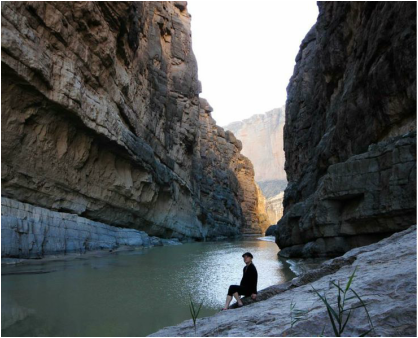
Recently I had an opportunity to stick my toes into the Rio Grande. The river is no longer the formidable barrier it once was, and it can seldom be rafted, but the mud along the bank still squishes. Birds still swoop at the surface, turtles still dive into it, the water still moves downstream, and it still smells like damp desert. I still love it.

We have a history, this river and I. Thirty-three years ago, I saw it for the first time. It might have been its historical significance or cowboy movie memories, or the surreal beauty of the land it divides, but I had goosebumps at first sight. And I fell in love, not just with the Rio, but with the rugged, wild terrain on both sides of it.

This Florida girl, accustomed to sandy beaches, lakes, crystal clear streams, swamps, and more greenery than is healthy, fell hard for the Big Bend country—everything about it. The immense open spaces with nothing to block the view, jagged peaks, hidden forests, steep canyons, and the widest sky I had ever seen, spoke to me in a way nothing ever had.

At the time, my familiarity with Mexico pretty much began and ended with Speedy Gonzalez cartoons and of course, all those insulting stereotypes from old westerns.

I stood at the top of a nature trail at Rio Grande Village in Big Bend National Park. The idea of a foreign land “right over there” was even more intriguing than the famous river. From the top of the trail I could admire both sides, the mountains that stretched out in all directions jutting towards the sky, the vegetation growing along the banks, and then I spotted a man, a Mexican man, dressed all in white and wearing a wide sombrero, hoeing in a garden in Boquillas, Mexico. Ordinary, you might say, but my heart rate sped up and I got a little teary-eyed. I wanted to laugh and cry and dance at the same time. And I had no idea why.

How would I have known that I would meet, fall in love with, and marry a Mexican man? Or that my future self would learn to speak Spanish and cook Mexican food? Or, that without question, I would take in a chubby little Mexican boy and raise him as my own? If you had told me I would stay up until two in the morning making tamales with my mother-and-sisters-in-law on Christmas Eve, I would have thrown up my hands and sworn there was no way that would ever happen.

I have spent so much time in Mexico it has become as much a part of my life as my country of birth. I’ve attended weddings, quinceañeras, funerals, births, and deaths—and more dances than I could ever count. I’ve wandered its shores, explored its mountains, and camped in its wilderness. I love its people with all my heart.

How would I have known then that I would go to work for a river outfitter and enjoy the work so much I would eventually own the company? I would raft all the canyons and most of them more than once, on trips guided by some of the most fun and life-loving people I have ever had the pleasure to know. Every river adventure was different and each held its own magic. There was always something new to learn or to admire or some side canyon to explore. After sumptuous dinners and campfire conversation, we would fall asleep under a ribbon of stars or stay up late to watch the full moon illuminate the canyon walls.

It runs in my veins now, this muddy river. Who knew it would be so hard to drag my toes out of its mud? 


 Many thanks to Molly Dumas for the photo!


1 Comment

Coming Home

7/10/2013

2 Comments

 
When I first decided to get away for a while, I only meant to experience the west, not have it invade my heart and soul. Somewhere on the list of national parks and other places I couldn’t wait to visit was a vague plan to return to Florida.

The first time my feet touched Big Bend National Park soil I was a mess, a runaway. Left behind was a man I had loved for eleven years. All I had to show for it was a divorce decree, memories, and experience—and the experience part I couldn’t appreciate yet. I was in a relationship but wasn’t ready for one, and it was going nowhere; and on top of that, my career had failed me. Or I had failed it. Success had been mine, but at what price? 

When a friend and I planned our trip, our ultimate destination was Alaska, but that would be after several months. The first stop was Big Bend because it was February when we left home, and the park was in Texas. How cold could it be, right? My friend wanted to skip Texas altogether. “Nothing in Texas but miles and miles of miles and miles,” was her favorite witticism. 

I always replied stubbornly, “You’ll see,” because one time I opened a book about America’s national parks to a page showing a deep canyon. Muddy water flowed through it, and standing at the edge on a pebbly beach was a cowboy on a horse. The text spoke of mountains and canyons and hundred-mile vistas. Without knowing anything more, I longed to go there. The header on the page read: Big Bend National Park, Texas. Texas? I didn’t care; I was going.

Approaching the park from Marathon, our first glimpse of The Chisos Mountains was surreal. They looked like a mirage, no more real than the mountain-like clouds you sometimes see on a distant horizon. It was a cool, misty day and for a while they disappeared altogether, and we decided they had been dark clouds after all. 

Santiago Peak drifted in and out of the mist as we passed it, and my friend said, “Typical Texas, they brag about everything, and even claim to have mountains—and this is it?” She was insulted.

“That’s only one mountain.” I was losing patience.

“Huh.” She was unconvinced.

There were more; I had seen the photographs.

As we progressed through the park, the entire landscape seemed alive, coming and going and disappearing again in the fog. 

“This is kind of creepy,” my companion commented. “Wasn’t that weird rock formation on the right a few miles ago?”

“Yes, but the road is winding. And I think there’re a lot of weird rock formations all over this park.” I already had a sense of it.

“And the plants are all prickly-looking,” she complained.

“Those are cactus,” I said, “and they’re beautiful.”

“Did you notice the tall, spindly plants with lots of branches? They look like spiders lying dead on their backs with a bunch of legs in the air.”

I laughed; they were weird all right.

The mountains were getting closer. Clearly they were not clouds. As the mist lifted, some new part of them would be exposed then it would settle again, hiding what had just been revealed.  

Meanwhile, we had not passed even one other vehicle. With the slinking fog and abandoned road that seemed to never get anywhere, the oddly shifting landscape was horror movie-ish. 

At last, we neared the park’s headquarters, Panther Junction. A sign declared there were three peaks behind it, Pummel, Wright, and Panther. We could see the bottom parts but whatever was above was shrouded in clouds, yet  those three mountains had a presence—that’s the only way I know to describe it. The promise of more was there, and we only needed to have patience.

We parked and got out of the car. The air was wet, but not tropical wet. This air was fresh and cool—mountain air. We breathed deeply of it.

“This is great,” my friend admitted.

    Then we stood at the farthest point of a nature trail, staring at the canyon’s deep cut and the rough rock formations and giant boulders and plants all over the big, wide, hugeness of it. 

“I told you there were mountains in Texas,” I said.

  She shrugged. “Who knew?”

  We hadn’t even seen the mountaintops and we were enthralled. While we stood there wondering at it all, the clouds dipped low and the sun burst out and we saw the peaks for the first time. 

  “Holy ...,” my friend said in a whisper. It was a lot more reverent than it sounds.

I had no words. I felt I had come home, and I would never be the same.


2 Comments
Forward>>
    Elizabeth A. Garcia, author

    Archives

    April 2018
    December 2017
    November 2016
    August 2016
    April 2016
    March 2016
    January 2016
    December 2015
    November 2015
    September 2015
    August 2015
    June 2015
    April 2015
    March 2015
    February 2015
    January 2015
    December 2014
    November 2014
    October 2014
    September 2014
    August 2014
    July 2014
    June 2014
    May 2014
    April 2014
    July 2013

    Pin any image
    from this page.

    RSS Feed

    Click "RSS Feed" icon to subscribe to Garcia's Blog feed.
    #garciabooks
    use this hashtag to find  Elizabeth A. Garcia; also use it to post about her.

    Links

    Alpine Daily Planet

    Big Bend River Tours

    Familias de Terlingua

    Front Street Books

    Marfa Book Co.

    Terlingua Trading Company

    Visit Big Bend

    Categories

    All

    A prickly perch
Deputy Ricos' Mountain

Copyright © 2014 Elizabeth A. Garcia 
All Rights Reserved


ASF Sites of Coyota Consulting